Global Law And Governance – information
On this page, you will find information related to the GLG program, including study plans and curricula.
FIRST-YEAR INFORMATION FOR THE GLOBAL AND LAW GOVERNANCE PROGRAM
- Breakdown of the 2026–2027 Academic Year :
WINTER SEMESTER SCHEDULE FOR THE 2026/2027 ACADEMIC YEAR
The official opening ceremony for the academic year will take place on October 1, 2026.
The faculty’s opening ceremony for the academic year will take place on September 26 at 10:00 a.m. in the Red Auditorium (2.20).
Classes begin on October 2, 2026, and continue through the winter semester until January 24, 2027.
THE WINTER SEMESTER RUNS FROM OCTOBER 1, 2026, TO FEBRUARY 21, 2027.
Days off from classes during the 2026/2027 winter semester:
October 31, 2026—Rector’s Day (part-time studies),
November 2, 2026 – Rector’s Day (full-time and part-time evening programs),
December 23, 2026, through January 6, 2027 – winter break,
February 8 through February 14, 2027 – intersemester break
The following dates are set for the winter semester exam period:
January 25 through February 7, 2027 – winter exam session
February 15 through February 21, 2027 – winter make-up exam session
Classes for the summer semester begin on February 22 and run through June 13, 2027.
2. Student Account :
At the University of Łódź, everything starts with access to the following systems:
student email,
USOSweb (where you’ll find your class schedule, grades, and course registration),
the Moodle platform,
Microsoft 365,
and the Eduroam network.
You’ll find activation instructions in the Student Zone—follow them as soon as possible to stay up to date with information.
Checklist to get started:
- activated email account
- USOS login
- access to Moodle
3. Contact for student matters:
All matters related to the course of study should be directed to the Student Services Department.
The supervisor for the Global Law and Governance program is:
Agnieszka Molicka, MA
Room: 2.27
Phone: 42 635 63 51
E-mail: agnieszka.molicka@wpia.uni.lodz.pl
4. Student ID card :
Each student will receive a student ID in one of two formats:
mLegitymacja – free of charge,
You can place your order via USOSweb or the USOS mobile app.
Starting October 1, you can apply for an mID card on the WPiA website under the “Student” tab in the Student Services section in the information for first-year students (instructions are available here)—this is your primary document that you will use at the University.
If you would also like to have a plastic version of the ID card, you should submit an application for its issuance to the Dean’s Office along with proof of payment. The cost of the plastic ID card is 22 PLN.
Faculty of Law and Administration, University of Łódź, PKO S.A. Bank, Branch II / Łódź
42 1240 3028 1111 0010 2943 5358
APPLICATION FOR AN ELECTRONIC STUDENT ID CARD in the form of an electronic process card
5. The Student Services Office :
The Student Services Office will be there for you throughout your studies. We’ll help you with matters related to student ID cards, certificates, applications, and other student-related paperwork.
We invite you to reach out and work with us. If you have any questions or concerns, we’re here for you and happy to help.
How can you contact us?
The best and fastest way to contact us is by email. Please send messages from addresses in the uni.lodz.pl domain.
Office Hours and Queue System
For your convenience, we’ve introduced a queue system—you can pick up a ticket:
- at the ticket machine in your department,or online via the app.
We also invite you to our in-person office hours, which are held: for full-time students:
- Monday 10:00 a.m.–12:00 p.m.; Tuesday 12:00 p.m.–2:00 p.m.; Thursday 10:00 a.m.–12:00 p.m.
- Wednesday and Friday—contact via email
for part-time students:
- Tuesday—3:30 PM–5:30 PM; Thursday—12:30 PM–2:30 PM; Saturday (on-campus session)—8:00 AM–11:00 AM
- Monday; Wednesday; Friday – contact via email
If you need an individual meeting with a member of the Student Services Department, a QUIET MEETING ROOM is available for students.
To schedule a meeting, please send an email to the staff member of your choice requesting a date and time for the meeting.
6. Withdrawal from studies :
If you wish to withdraw from your studies, please send an email to the dean's office responsible for your field of study with a request to cancel your enrollment.
Useful links:
Rules of Study 2026-2027
Annex 10 Faculty of Law and Administration
AMOUNT OF FEES FOR EDUCATIONAL SERVICES AT THE UNIVERSITY OF Lodz IN THE 2026/2027r ACADEMIC YEAR
Annex No. 14 to Regulation No. 124 of the Rector of the UL of 30.04.2026
Annex No, 16 to Regulation No, 124 of the Rector of the UL of 30,04,2026
Annex No. 9 to Regulation No. 124 of the Rector of the UL of 30.04.2026: rules for collection and exemption from fees for educational services at the University of Lodz
7. Oath and Declaration :
Very important: Every newly admitted student must—within 7 days of the start of classes—accept the following in the USOSweb system:
The Oath,
A statement confirming that you have read and understood the rules regarding payment for educational services.
What does this statement mean?
It is a confirmation that you are familiar with and accept:
- the rules for calculating fees,
- the deadlines for payment,
- situations in which additional costs may arise (e.g., for repeating a course),
and the consequences of failing to pay fees—including, in some cases, removal from the student roster.
Without accepting these documents, you are not formally students of the University of Łódź—you cannot enroll in classes or use the USOS system.
8. First-Year Advisors :
First-Year Mentors support students during their first months of college. They help students adjust to academic life, provide guidance on how to organize their studies, and offer assistance with matters related to their academic progress and life at the department.
- Global Law and Governance – dr Izabela Florczak
How can I get a handle on my studies?
- Class Schedule and Organization of the School Year :
You can find the class schedule on USOSweb. At first, everything may seem complicated—that’s normal. During the first week:
check the classrooms and buildings,
write down important dates (classes, exam period, assessments),
ask your year advisor if anything is unclear.
The University of Łódź also offers onboarding materials to help you understand how the academic year works.
In accordance with the rules in effect at the Faculty of Law and Administration at the University of Łódź, students register for classes on their own. Links to the class schedules on Usosweb are made available to them well in advance on the faculty website.
The registration schedule and detailed information are published on the faculty website.
2. Winter Semester Schedule for the 2026/2027 Academic Year :
Classes begin on October 2, 2026, and continue through the winter semester until January 24, 2027.
Classes for part-time distance learning programs begin on October 24, 2026.
For the part-time first-cycle administration program, classes begin on November 7, 2026—9 sessions.
The winter semester runs from October 1, 2026, to February 21, 2027.
Days off from classes during the 2026/2027 winter semester:
October 31, 2026 – Rector’s Day (part-time programs),
November 2, 2026 – Rector’s Day (full-time and part-time evening programs),
December 23, 2026, through January 6, 2027 – winter break,
February 8 through February 14, 2027 – intersemester break
The following dates are set for the winter semester exam period:
January 25 through February 7, 2027 – winter exam period
February 15 through February 21, 2027 – winter make-up exam period
Classes for the summer semester begin on February 22 and run through June 13, 2027.
3. Library and Campus :
You have access to:
the University of Łódź Library,
the Library of the Faculty of Law and Administration at the University of Łódź,
study and work areas,
sports facilities,
dormitories, and support centers.
On the University of Łódź onboarding page, you’ll find maps and descriptions of these locations to help you navigate the campus.
4. Regulations, Orders, and Forms :
You can find useful regulations, directives, and forms on our page dedicated to legal documents. There you will find, among other things, the academic regulations, information on tuition fees, and scholarship applications.
5. For Drivers - Student Parking:
Students at the Faculty of Law and Administration (WPiA) at the University of Łódź (UŁ) can apply for a parking permit and an access pass. You’ll find the online form on the faculty’s website once registration begins.
The fee for the winter semester is 300 PLN.
Pick up your cards after 5 business days in Room 2.02, Administrative Department.
If you have any questions, please contact us at: parking_adm@wpia.uni.lodz.pl
Useful information
Summer semester schedule
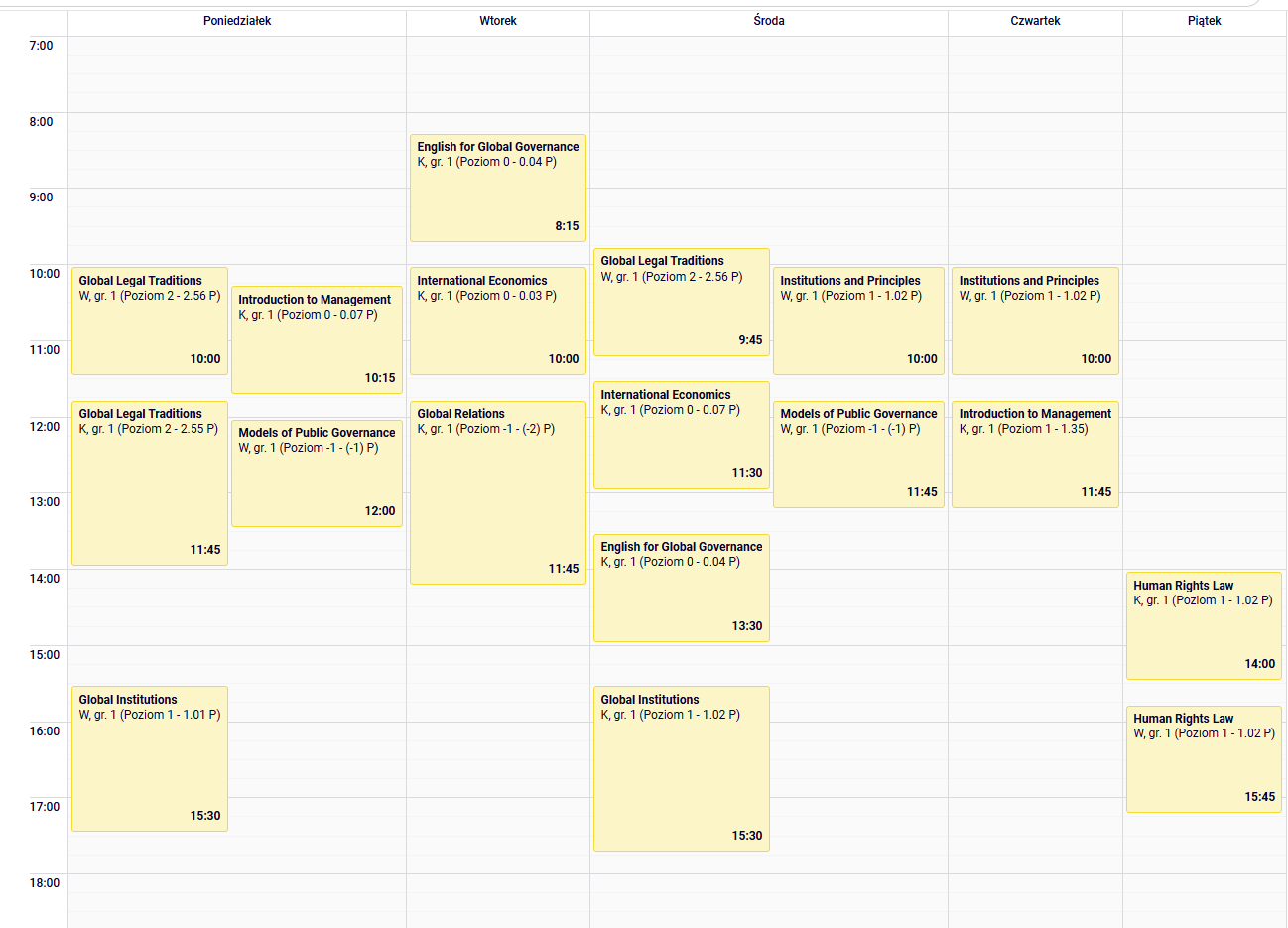
Class schedule - Link First Year 26/27
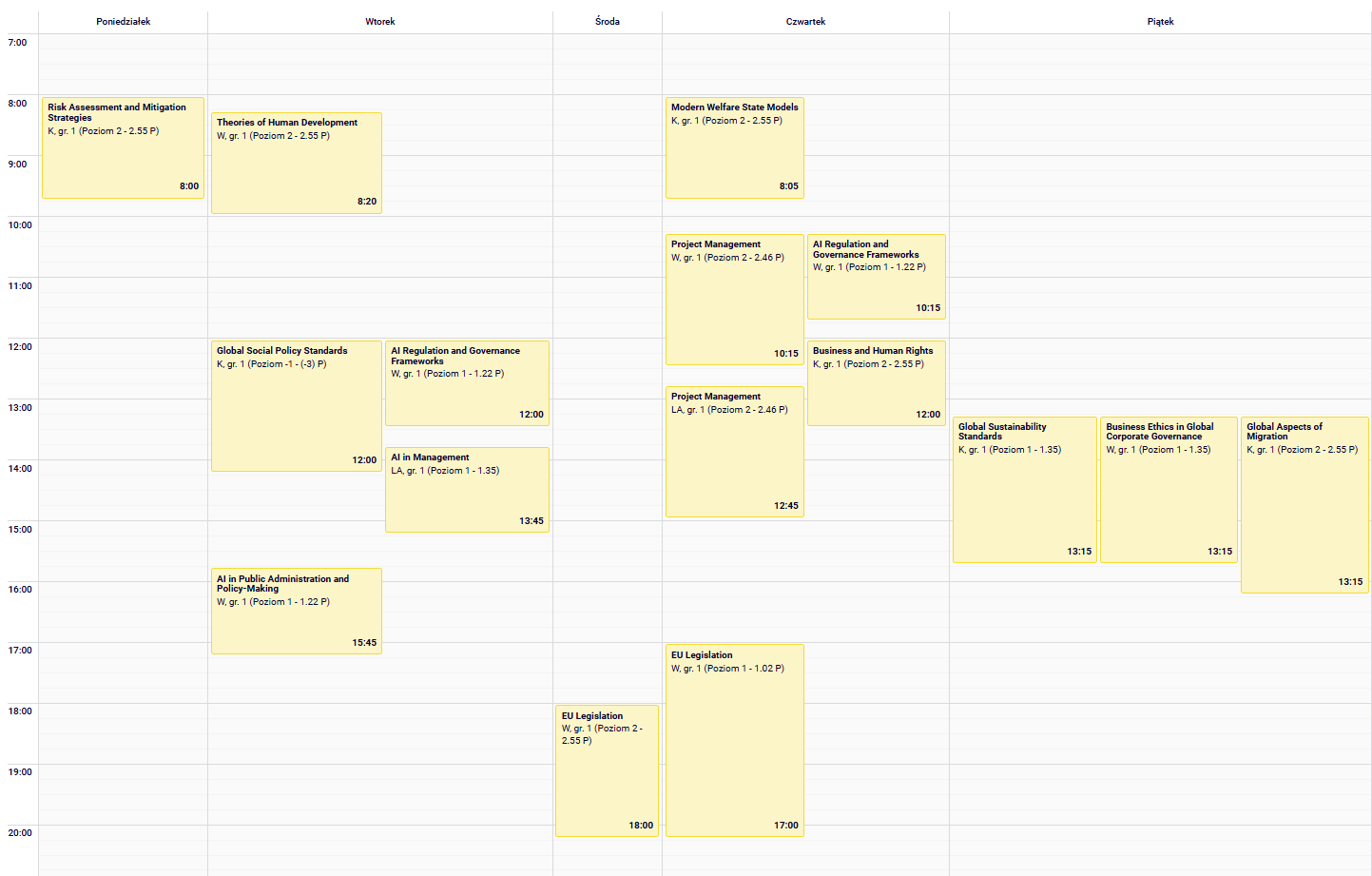
Class schedule - Link Second year
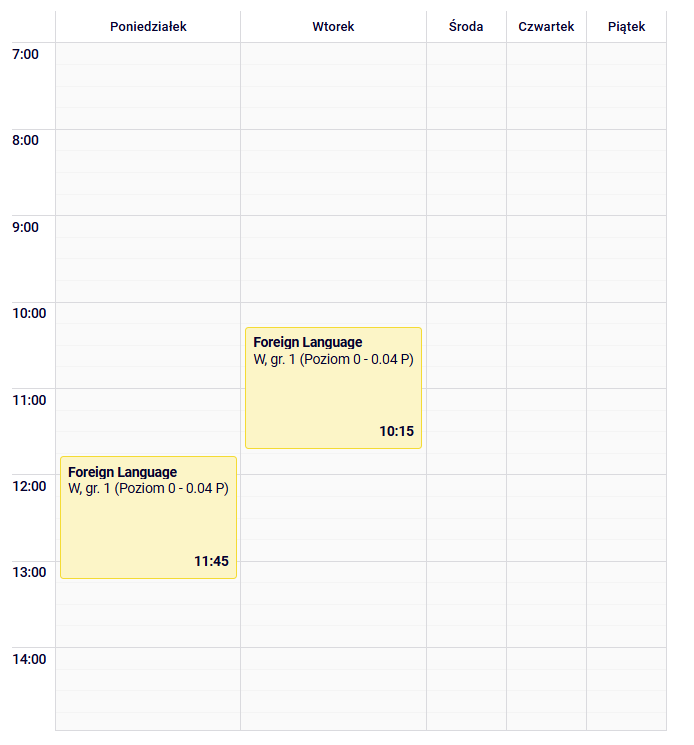
Class schedule - Link Second year
ELECTRONIC DELIVERY – INFORMATION FOR STUDENTS
What are e-Deliveries?
e-Deliveries are the electronic equivalent of a certified letter with return receipt. The system enables legally valid delivery of correspondence between a public entity (university) and an individual (student).
Correspondence can be delivered via:
• PURDE – Public Registered Electronic Delivery Service (delivery to an electronic delivery address – ADE, with legal effect),
• PUH – Public Hybrid Service (electronic correspondence converted by the operator into paper form and delivered traditionally).
Basic Concepts
Electronic Document
A document created in digital form (e.g., an electronically generated PDF file) that can be signed with an electronic signature.
Digital Reproduction
A scan or photograph of a paper document. It is not equivalent to an electronically signed electronic document.
ADE (Electronic Service Address)
An individual address enabling the receipt and sending of correspondence in the e-Service system.
Proof of receipt
An electronic confirmation of document delivery that has specific legal effects.
How can a student send a document to the university via e-Delivery?
Students can send letters to the university through the PURDE service.
For the delivery to be legally valid, the document must:
• be in electronic form,
• be signed with an electronic signature.
Acceptable forms of submitting a document
✔ Entering the full text of the document in the “Message Body” field in the e-Delivery inbox and selecting the “Sign and Send” option
✔ Attaching an electronic document (e.g., an electronically generated PDF file) signed with an electronic signature
Unacceptable forms (invalid delivery)
✖ a scan of a handwritten paper document
✖ a photo of a document with a handwritten signature
✖ a file containing a digital reproduction of a signature (e.g., a pasted image of a signature)
✖ an electronic document without the required signature
A scan or photograph of a signed document does not constitute an electronic document within the meaning of the regulations and does not produce the legal effects specific to e-Deliveries.
Accepted electronic signatures
Documents submitted to the university must be signed with one of the following signatures:
Qualified signature
An advanced electronic signature created using a qualified certificate. It is equivalent to a handwritten signature.
Trusted signature (Trusted Profile)
A signature created using a free tool available on the gov.pl website, confirming the identity of the signatory.
Personal signature
A signature created using an e-ID (an ID card with an electronic layer).
Legal Effects of Service
Service of a document to an electronic service address has legal effect:
• upon receipt of the correspondence,
• or 14 days after it is received at the ADE (so-called deemed service), even if the addressee has not opened it.
This means you need to check your e-Delivery inbox regularly.
Can documents still be submitted in traditional formats?
Yes. The introduction of e-Delivery does not preclude the use of traditional methods. Documents can still be submitted:
• in paper form (e.g., by mail),
• in person at the university.
Recommendation for students
We encourage students to:
• set up a free ADE address,
• use e-Delivery as a secure and legally equivalent form of correspondence,
• ensure that the document being sent is in electronic form and has been properly signed.
Correspondence sent by an individual to a public entity using the PURDE service is free of charge.
How to set up an electronic delivery address (ADE)?
Setting up an address is:
• free of charge,
• voluntary for individuals,
• available online at:
Once the address has been created, the student gains access to the inbox in their gov.pl account.
In the inbox settings, you can link the ADE to an email address to receive notifications about new messages. It is recommended to use a personal email address rather than a university email address, which is only valid for the duration of your studies.
People responsible for supporting the GLG programme
People responsible for supporting the GLG programme
People responsible for supporting the GLG programme:
Vice Dean for the Study Programme in Law
t. 42 635 63 53
room no. 2.31
Office Hours :
Until 25 July 2025, contact by email at: prodziekan.sdw@wpia.uni.lodz.pl
- Monday 10:30 - 11:30
Vice Dean for International Cooperation and Projects
dr Izabela Florczak
t. 42 635 40 45
room no. 3.72
Office Hours
- Monday 11.00 - 12.00
Contact via e-mail at: prodziekan.zagranica@wpia.uni.lodz.pl
For urgent matters, please contact the Secretariat.
Faculty Office (Dean’s Office) Contact – Ms Agnieszka Molicka (agnieszka.molicka@wpia.uni.lodz.pl)
→ The Faculty Office supports you with administrative matters, such as issuing and extending student ID cards, providing certificates of student status, entering grades in the USOS system, and documents needed for scholarships